


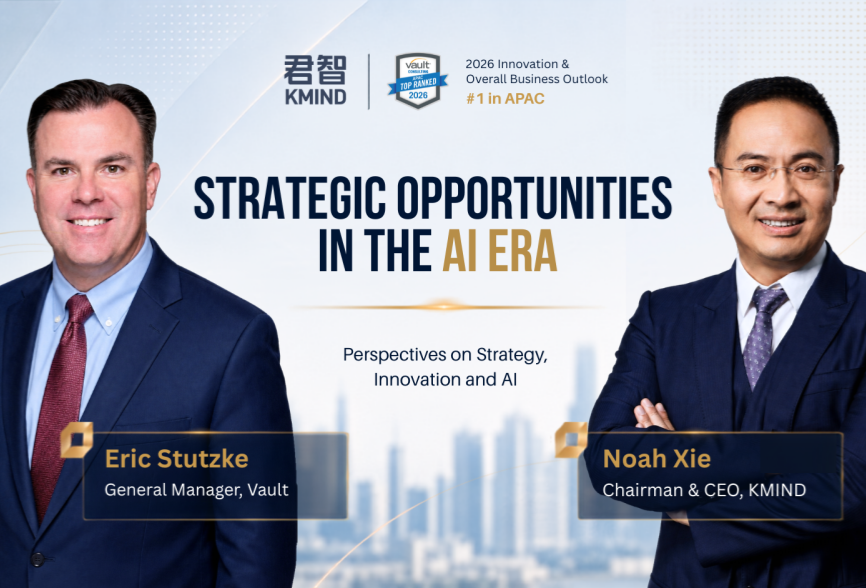

【Editor’s Note】
As the AI wave rises, companies urgently need strategic leadership that can truly drive breakthrough growth. In the 2026 Asia-Pacific consulting rankings released by the authoritative firm Vault, Junzhi Strategic Consulting made the list for the fourth consecutive year. With its proprietary strategic system and outstanding client results, it ranked No. 1 in both Vault Asia-Pacific’s “Most Innovative” and “Most Promising Business Prospects” consulting firm categories.

Vault is internationally recognized as the most authoritative and influential bellwether in global consulting. Founded in 1996 and headquartered in New York, USA, it conducts comprehensive evaluations of consulting firms worldwide each year based on anonymous surveys of tens of thousands of consultants and industry experts globally. For a long time, Vault rankings have been widely cited by major international media such as The New York Times, The Wall Street Journal, and Forbes.
As the only Chinese consulting firm to top two Vault lists, Xie Weishan, Chairman of Junzhi, was invited to engage in an in-depth dialogue with Eric Stutzke, Global General Manager of Vault. Eric commented: "Junzhi has helped over 100 companies achieve sustainable growth. Through market validation, its strategic thinking and methodology can effectively help global companies achieve competitive breakthroughs."

In the dialogue, Xie Weishan shared his unique insights into the Chinese market and his forward-looking perspectives on the essence of business competition in the AI era. Below is the transcript of the conversation:
【Full Text】
Eric Stutzke : Kmind Consulting was recently ranked number one in both Vault's 2026 Best Consulting Firms in Asia Pacific rankings for Innovation and Overall Business Outlook. What do you believe has been the key driver behind this recognition?Noah Xie:I think the first driver is we are committed to driving the outcome and the result for our clients. What we do is help our clients grow their revenue, profit, and the business. To achieve that goal, we are reshaping the way we provide consulting services, and how we set internal KPIs.
The second driver is we have spent a lot of effort understanding the knowledge and theories of effective Western consulting practices. Meanwhile, we have also discovered that Eastern wisdom, such as The Art of War and Taoism, can be very effective in helping companies stand out in business competition and achieve great business results. Kmind has managed to blend the best of the East and of the West. We are creating a new species based on this perfect blend.
Noah Xie:In terms of innovation, I would like to share my ideas on some of the fundamental methodologies at Kmind. A lot of our inspiration is from The Art of War, and I believe that it's not just a book about war, it's more about how to win competition.
In October of this year, my book, Art of Strategy, will be published. It will include my in-depth perspectives on competition, the consulting industry in China, and a lot of stories about Kmind.
I believe that to build a successful consulting company, you need to master the power of both science and art. In The Art of War, Sun Tzu said that to win a battle against your enemy, you should not only deploy your armies conventionally, but you also need to initiate a surprise attack–something that your enemies would never think about. We bring that idea to our consulting practices.
In terms of conventional deployment, we help our clients improve their product, operations, and daily business operations. That is the fundamental part. Beyond that, we also push our clients to be innovative, to be counterintuitive, because that is the only way to go beyond the limit and out-compete their competitors. When we deliver our consulting reports to our clients, we will have two reports: one about how to improve their fundamental capabilities, and a second about how to design a very innovative and surprise-oriented initiative that can help them advance to the next level.
In terms of the first report, the fundamental operations, it is mainly based on the Western consulting practices. But the second part, the surprise part, mainly gains inspiration from Eastern wisdom.
Another part of innovation is how we help clients design their products. We have designed a model called the Strategic Product Pyramid, that can effectively help our clients design strategic products that can out-compete and outsell competitors. The pyramid connects three very important pillars: the customer's demand, the overall macro-trend, and the business model. Only when the products can fit these three basic requirements can it be a compelling product. Additionally, around the pyramid, we have a line that connects the products with the hearts and the minds of consumers. It represents our focus on the demand and requirements of customers.
I brought this model to Harvard and Yale University in April of this year, and the model was well received. Going forward, we will embed our artificial intelligence systems into the model to help our clients better leverage these innovative methods.
Noah Xie:Kmind is still a very young company. We were established 11 years ago, and over the past several years we have managed to help a lot of Chinese enterprises become leading players in their industries. We have also managed to help seven of our clients break their revenue threshold of 10 billion RMB. We gained a lot of new knowledge based on our practices on the front line, and we believe this knowledge and perspective can offer great value to global businesses. That is why I decided to share my experience and knowledge with Ivy League universities four years ago. We started with Harvard University, and the knowledge we shared was well received. I think there are several reasons for this.
First, the knowledge itself is valuable, and it is also highly relevant to both the business and academic worlds.
Second, Kmind's knowledge is based on our real practice, which is tested in the competitive Chinese market. Our cases and theories are mainly from the Chinese market. However, I believe this knowledge is relevant globally, and can offer insights to MNCs and global companies.
Third, Kmind's methodologies combine Western consulting practices with Eastern wisdom, which is also one of the reasons why they have attracted attention and curiosity from academics and entrepreneurs in the West.
Fourth is the global trend. If you take a look at the profit rate of the economy, it has actually gone down over the past 20 years. This is a result of hyper-competition globally, which means that companies globally face the same question: how do we better survive and thrive in the hyper-competition age? Kmind's strategic methodologies are highly aligned with these global business trends and market demand.
Noah Xie:Yes, we do see that a lot of multinational companies are leaving the Chinese market.
On the surface, we see that Chinese enterprises are developing very fast, they are very effective, and I think behind that, there lies a different understanding of how to compete and thrive in the Chinese market. I think that this kind of situation is not merely driven by policies, but there are several underlying reasons behind it.
First is about the knowledge of competition. As you know, in China, we already put a large effort into learning Western theories, Western philosophies, and also practices from business schools. Chinese companies and entrepreneurs have made a great investment in learning these Western ideas and theories. Compared with the Western competitors, we are also empowered by the traditional Chinese wisdom, especially in terms of how to compete in the Chinese market. This is one of the advantages that lots of Chinese companies possess.
Secondly, in China, competition is always associated with the idea of harmony. Meaning that everyone can be different, and everyone can hold their unique positions. They don't need to initiate a zero‑sum game. Instead, everyone can compete and coexist to reach a win‑win result.
Thirdly, I must mention the uniqueness of the Chinese market. If you look at the industry clusters and the supply chain in China, it is fantastic. In major cities such as Beijing, Shanghai, Suzhou, Wuxi, and Hangzhou, there are major industrial clusters. In those clusters, university labs, industries, companies, and supply chains are all highly concentrated, providing great efficiency for innovation. All of these factors enable the Chinese industry to develop and evolve rapidly. As a result, the supply chain in China is highly efficient, innovative, and cost‑effective.
I think the uniqueness of the Chinese market is something Western MNCs should pay close attention to. Success in the Chinese market can help companies build stronger capabilities for global competition.
Lastly, because of the sheer size of the Chinese market, it occupies a great amount of share of the global GDP and the global economy. For MNCs seeking to maintain their global competitiveness, understanding and engaging with the Chinese market can provide valuable opportunities for growth and innovation.
Noah Xie:I think a lot of AI and tech firms are facing a significant challenge. They have a lot of great technology, and naturally, they're thinking about how they can commercialize this technology, and how they can find the scenarios to adopt and apply this technology. However, this technology‑first approach may lead to a disconnect between technological innovation and real market needs, which could create challenges for the commercialization of AI and technology.
I think these tech firms need to change their thinking. Instead of just focusing on the technology itself, focus on the market and the consumers. For example, they should base their technology on the pain points of clients and think about what technology can help clients address problems and issues in their daily life.
Overall, I'd like to say that many tech firms need to move beyond this tech‑heavy thinking. Instead, they should adopt customer‑centric thinking.
Noah Xie:In my previous answer I talked about the importance of customer‑centric thinking. Nowadays, when companies adopt this kind of thinking and identify the pain points of customers, they can then leverage the power of AI to quickly scale their business. But what is the natural result of this? If you look at what's happening in China, when you create this scalable business model, a lot of competitors will follow and imitate. As a result, your profit will decline because your competitors are all focused on the same thing. They want their own piece of pie, and the blue ocean will quickly be transformed into a red ocean.
I think what makes Kmind's methodology so unique and valuable is our expertise in helping clients secure the blue ocean and to prevent the blue ocean from becoming the red ocean, enabling clients to find their unique competitive advantage to sustain competitiveness. In the age of AI, as technology matures and efficiency increases, the competition will become even more intense. This is going to lead to more homogeneous and cutthroat competition. Only by gaining a unique competitive advantage can companies really survive and thrive. I think Kmind can make unique contributions by applying the wisdom of The Art of War, which has been tested over the past 2,000 years. I still believe that it has a very significant influence on the whole business world today.
Additionally, the ancient Eastern wisdom represented by The Art of War brings a unique perspective that is less commonly found in traditional Western consulting practice. I believe that is also the reason why, when I went to Harvard and shared my perspective and thinking, the knowledge was so attractive to western academics, scholars, and entrepreneurs.