


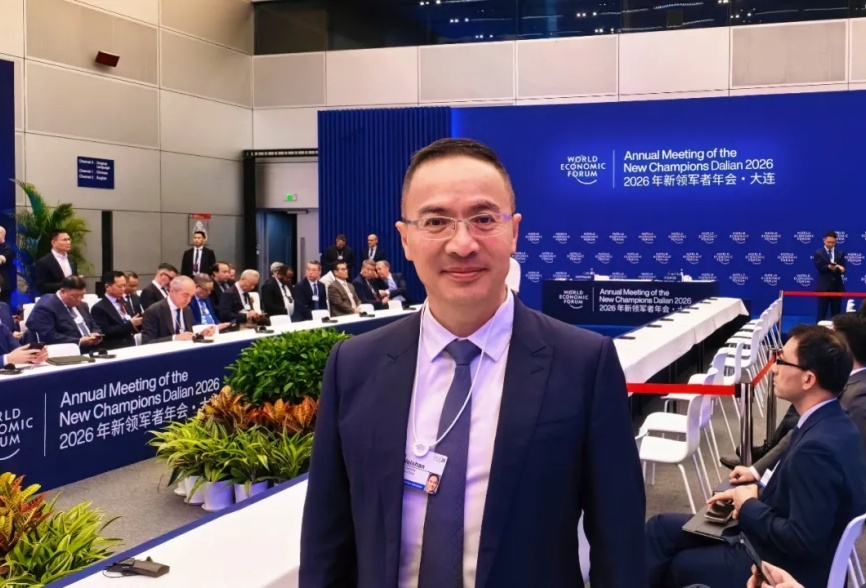
As a representative of China’s strategic consulting industry, Noah Xie, founder and chairman of Kmind Strategic Consulting, was invited to attend this year’s forum. He participated in several closed-door meetings, including the “Premier Li Qiang Symposium with Business Representatives,” the “High-Level Dialogue on China’s Megacities,” and “Innovation Implementation, Smart Global.” He also delivered a speech at the “Too Small To Fail” session, sharing Junzhi’s Next-Generation Strategy.

Noah Xie, Chairman of Kmind Consulting, invited to the Premier’s closed-door meeting
Noah Xie exchanged views with representatives from global political, business, and academic circles on topics such as “innovation at scale,” “global competitiveness of Chinese enterprises,” and “strategic breakthroughs for enterprises in the AI era.” Together, they explored the innovation logic of Chinese enterprises in the AI era and how China’s strategic consulting, based on Chinese corporate practices, can provide inspiring “Chinese solutions” for global enterprise innovation and growth.

Noah Xie, Chairman of Kmind Consulting, delivering a speech at the forum
Kmind’s views drew widespread attention. During the forum, Noah Xie also accepted interviews with multiple authoritative media outlets, including Xinhua News Agency, China News Service, CGTN, Yicai, China Daily, Tencent Finance, Sina Finance, and National Business Daily.
*The following content is from the full text of the XinhuaNet interview:
Source: XinhuaNet Editor: Wu Yan Original Title: “Building Bridges Through ‘Innovation at Scale’ to Share Opportunities with the World—An Interview with Noah Xie, Chairman of Junzhi Strategic Consulting”
From June 23 to 25, the World Economic Forum’s 17th Annual Meeting of the New Champions (Summer Davos) was held in Dalian, Liaoning Province. With “Innovation at Scale” as its theme, the forum brought together more than 1,700 guests from over 90 countries and regions to jointly explore new pathways for global economic development. During the event, Noah Xie, Chairman of Kmind Strategic Consulting, was interviewed by XinhuaNet.

Noah Xie, Chairman of Kmind Strategic Consulting, receiving an exclusive interview
XinhuaNet: What signals do you think the forum conveyed by setting “Innovation at Scale” as its theme?
Noah Xie: The reason “Innovation at Scale” became the focus of this year’s forum lies in the combined support of global technological evolution, industrial foundation, and international consensus on cooperation. The global economy is currently at a critical window of technological transformation and economic growth. Frontier technologies such as artificial intelligence are accelerating the reshaping of industrial landscapes, and all sectors are focusing on the implementation and transformation of innovation—this is highly timely. As the world’s second-largest AI market, China has a complete industrial system and rich application scenarios, which can provide fertile ground for the scaled implementation of innovation. More notably, this forum gathered political leaders, business leaders, and experts from over 90 countries and regions, reflecting the international community’s broad recognition of inclusive and sustainable development. With multiple favorable conditions combined, “Innovation at Scale” has become not only a technological development issue but also a shared development opportunity for global industrial upgrading and economic quality improvement.
XinhuaNet: From Junzhi’s practice, what support does the Chinese market provide for “Innovation at Scale”? What unique advantages have been formed?
Noah Xie: In recent years, Kmind has served many enterprises in depth, and one deep impression is that China’s support for “Innovation at Scale” is systemic rather than single-dimensional. From the perspective of industrial foundation, the continuous construction of a unified national market has effectively promoted efficient matching between supply and demand. China is the only country in the world with all industrial categories. Its full-chain capabilities from R&D validation to manufacturing delivery enable innovative achievements to be scaled up more smoothly. At the same time, the domestic market has broad coverage and rich demand levels. Any good idea has room for transformation, and the continuous release of new consumer demand also provides strong traction for innovation. At the level of technological application, China has rich data resources, diverse application scenarios, and a strong talent pool, making it a unique global “testing ground” for AI training and implementation. This gives China huge market potential in the field of AI-native applications, opening broad space for “Innovation at Scale.” In addition, the uniqueness of the Chinese market is reflected in policy coordination and industrial ecology. Government departments efficiently coordinate in key industrial areas and continuously optimize approval processes, providing strong guarantees for accelerating the implementation of innovative projects. The tight coupling between R&D, manufacturing, and suppliers has formed a collaborative efficiency difficult for other economies to replicate. Over the past 20-plus years, the total number of Chinese engineers has continued to increase and is deeply embedded in the above industrial ecosystem. Large industrial clusters have also formed in Beijing, Shanghai, Shenzhen, Suzhou, Wuxi, and other places, with universities, laboratories, suppliers, integrators, and application environments highly concentrated. This integrated layout of “government, industry, academia, research, and application” injects continuous talent momentum into “Innovation at Scale.”
XinhuaNet: What suggestions do you have for enterprises to advance “Innovation at Scale”?
Noah Xie: Based on Kmind’s practical observations, enterprises generally face a real challenge when advancing innovation: product development must balance technological leadership, diverse needs, and internal resources. As a result, R&D, product, and operations often work in silos, and the value perceived by customers often misaligns with the cognition transmitted internally. In terms of product development, I believe enterprises need to find a core product or a series of product solutions that can carry the strategy. Around this development approach, we build a triangular cone model. Based on the “Value Triangle”—which includes the essence of demand, the trend of the times, and the business model—it connects strategy, product, and brand to achieve integration of product and sales. This model has helped enterprises such as Fotile and Yadea create multiple strategic products and has been promoted and implemented in more enterprises. The innovation paths and growth methods formed by Chinese enterprises in complex markets are gradually providing local practical references for the development of global business theory. I hope the triangular cone model can help more enterprises find certainty of growth amid uncertainty. From a deeper perspective, the long-term foothold of enterprise development lies in deepening user value. With the development of artificial intelligence, a large number of technology-based enterprises have emerged, and hardcore technology alone is no longer sufficient to build lasting advantages. Enterprises should “begin with the end in mind,” allocate resources and organize operations around creating unique customer value, and find differentiated paths to breakthrough.
XinhuaNet: At this year’s Davos forum, international guests’ attention to the Chinese market remains high. What changes have you observed? What suggestions do you have for multinational companies to achieve localized “Innovation at Scale” in China?
Noah Xie: At this Davos forum, I felt strong confidence in China from international guests. In addition to the huge traction of China’s super-large market demand, a notable change is that multinational companies’ positioning of China is shifting—China is becoming an accelerator for global innovation. For example, China’s complete industrial supporting system helps accelerate the transition of scientific and technological achievements from the “laboratory” to the “application field.” In China, regulatory approvals can advance quickly; technology and products can be rapidly iterated and upgraded; enterprises can sharpen their capabilities through competition and conduct large-scale stress tests before global promotion. Based on these changes, the Chinese market remains worthy of deep cultivation as always. Multinational companies should grasp the above-mentioned policy environment, R&D intensity, and talent advantages. More importantly, they should see that China is not just a market but also a learning ground. Here, one can learn from Chinese enterprises’ agility and resilience in capturing user needs, adapting to market changes, and responding to external shocks. One can also learn from the integrated application of Eastern and Western wisdom in business practice. China is becoming a key link in the global innovation system, and the deep cultivation and learning of multinational companies here is also an important process for them to accumulate “Innovation at Scale” capabilities.